Starting and other high-power battery applications are very different from conventional energy-storage systems. A larger Ah capacity alone does not necessarily mean a cell is better suited for starting.
For applications requiring very high current within a short period, factors such as pulse discharge capability, internal resistance, low-temperature performance, cell size and pack connection design become especially important.
This is where the EVE C46PH 3.2V 21Ah LiFePO4 cell becomes particularly interesting.
Despite its compact 46mm-class cylindrical format, the C46PH combines 8C continuous discharge, an official 30C pulse discharge rating, 5C fast charging and very low internal resistance. More importantly, real customer testing has demonstrated burst discharge performance up to 70C, making this cell worth a closer look for starting and other demanding high-power applications.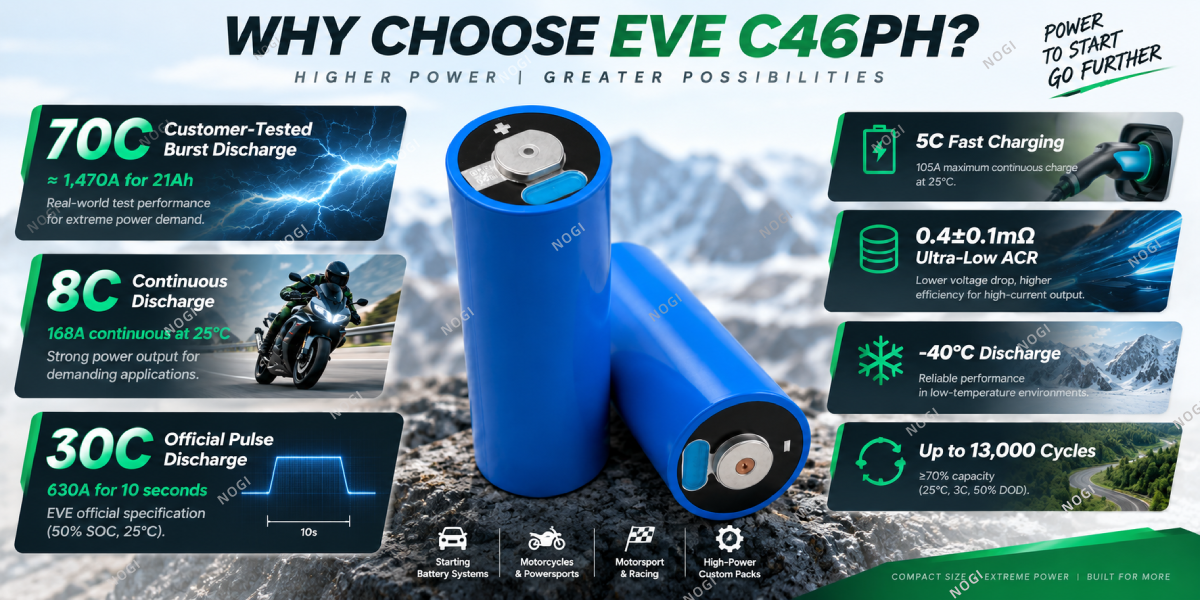
When selecting cells for a conventional energy-storage battery, capacity and cycle life are often among the main considerations.
Starting batteries have a different job.
A starter battery may need to deliver a very high current for only a few seconds. This means the battery needs to maintain useful voltage while handling a sudden high-current load.
For this reason, cell selection for starting applications should consider more than Ah capacity. Important factors include:
A compact 21Ah cell with strong power characteristics can therefore be more interesting for certain starting applications than a larger cell designed primarily for energy storage.
30C Maximum Pulse Discharge
Equivalent to approximately 630A for 10 seconds at 50% SOC and 25°C.
5C Maximum Continuous Charge
Equivalent to approximately 105A at 25°C.
0.4±0.1mΩ Initial ACR
The low internal resistance is particularly relevant when high current is required.
-40°C to 65°C Discharge Operating Range
Providing flexibility for applications exposed to demanding temperatures.
Up to 13,000 Cycles
EVE specifies 13,000 cycles to at least 70% capacity under test conditions of 25°C, 3C and 50% DOD.
Together, these specifications make the C46PH very different from a typical LFP cell focused mainly on energy capacity.
This is where the C46PH becomes even more interesting.
EVE officially specifies a maximum pulse discharge of 30C for 10 seconds at 50% SOC and 25°C. For a 21Ah cell:
21Ah × 30C = 630A
However, a customer evaluating the C46PH for a demanding high-current application carried out additional real-world testing.
During customer testing, the cell demonstrated burst discharge performance up to 70C.
For a 21Ah cell:
21Ah × 70C ≈ 1,470A
Up to 70C Burst Discharge
Approx. 1,470A
30C Maximum Pulse Discharge
630A | 10 Seconds | 50% SOC | 25°C
The distinction between these two figures is important.
The 70C result is real customer test data, not EVE's official rated pulse-discharge specification. It should therefore be viewed as additional real-world performance reference rather than a replacement for EVE's official 30C rating.
For battery designers evaluating cells for starting or other very high-current applications, however, this type of real-world testing can provide useful additional insight into the C46PH's short-duration power potential.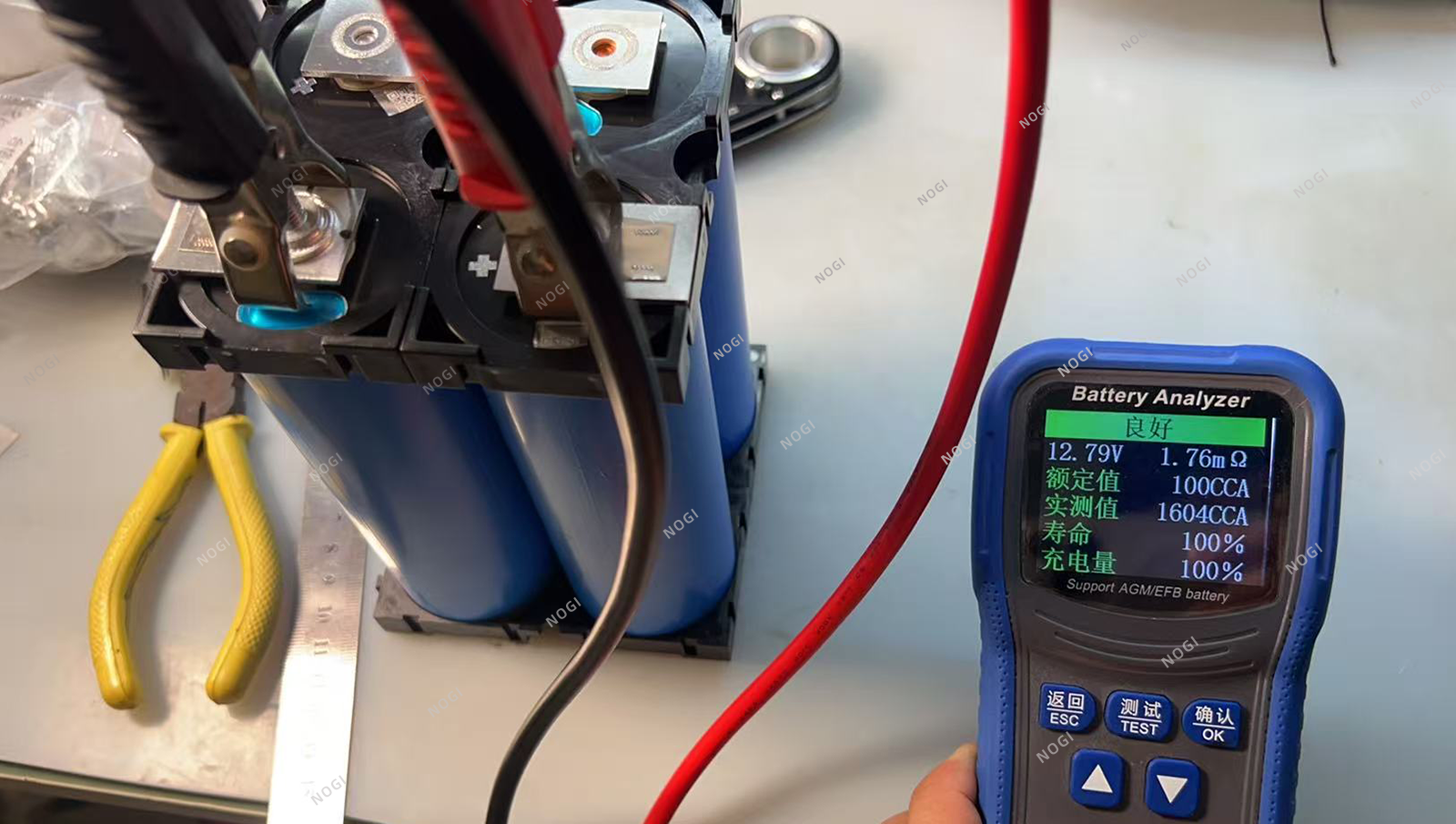
High current alone does not tell the whole story.
When a battery delivers a large amount of current, internal resistance contributes to voltage drop and heat generation. This is why low internal resistance is particularly valuable for starting and other high-power applications.
EVE specifies an initial ACR of:
0.4±0.1mΩ at 50% SOC, AC 1kHz
This very low ACR is one of the reasons the C46PH is worth considering for high-current battery designs.
If your customer's actual test showed 0.48mΩ, this result also falls within EVE's specified initial ACR range.
For NOGIPower, we recommend showing the two figures separately:
EVE Specification: 0.4±0.1mΩ Initial ACR
Customer Test: 0.48mΩ Measured ACR
This provides customers with both the manufacturer's specification and real-world test reference without confusing the two.
The EVE C46PH measures approximately:
Diameter: 46.8±0.3mm
Height: 146.4±0.4mm including terminal
Weight: 510±10g
Its compact cylindrical format gives battery designers greater flexibility when balancing available installation space, required current and pack configuration.
This is especially useful for applications such as motorcycle starter batteries and performance vehicles, where installation space can be limited but strong current output is still required.
Instead of simply choosing a larger-capacity cell, designers can evaluate whether a compact high-power cell configuration better matches the actual application.
Starting performance becomes more challenging as temperatures fall, making low-temperature capability another important consideration.
EVE specifies a discharge operating temperature range from -40°C to 65°C for the C46PH.
However, this should not be interpreted as meaning the cell can deliver identical power at -40°C and 25°C.
Actual high-current performance at low temperatures depends on factors such as cell temperature, SOC, required current, pulse duration and battery pack design.
For projects involving cold-weather starting, these conditions should therefore be evaluated as part of the complete battery-system design rather than relying on the minimum temperature specification alone.
Based on its combination of high current capability, compact dimensions, low internal resistance and wide operating-temperature range, the C46PH is particularly interesting for:
Starting Batteries — applications requiring strong short-duration current to start an engine or equipment.
Motorcycle & Powersports Starter Batteries — where compact dimensions and strong pulse power are both important.
High-Performance Electric Motorcycles — battery packs requiring higher continuous power for acceleration and demanding operation.
Motorsport & Racing Systems — applications where high current capability and compact battery design are important.
Industrial Starting Systems — specialized machinery and equipment requiring short-duration high current.
Custom High-Power LiFePO4 Packs — projects where standard energy-focused cells may not provide the required power characteristics.
No.
This is an important distinction for any engineer or battery pack developer considering the C46PH.
The official EVE specification remains 30C maximum pulse discharge for 10 seconds under specified test conditions.
The up-to-70C result comes from real customer testing. It demonstrates the cell's potential under a particular test setup, but it should not automatically be used as the design limit for every battery pack.
High-current performance can be affected by:
SOC and cell temperature
A cell can behave differently at different states of charge and temperatures.
Pulse duration
A very short burst and a 10-second discharge are not equivalent operating conditions.
Connection resistance
Busbars, welding, terminals and other electrical connections become increasingly important at very high currents.
Thermal management
High-current operation can generate significant heat within both the cell and connections.
Pack configuration
The number of cells in parallel directly affects the current required from each individual cell.
For this reason, a battery system should be designed according to the required current, duration and actual operating conditions, rather than simply using the highest C-rate observed in one test.
If you are evaluating the EVE C46PH for a new battery project, send NOGIPower your application requirements and expected quantity. We can help evaluate whether the C46PH is a suitable cell for your battery system.
Learn more about the EVE C46PH 3.2V 21Ah High-Power LiFePO4 Cell →

